
"The weather patterns are not the same as when I was growing up."
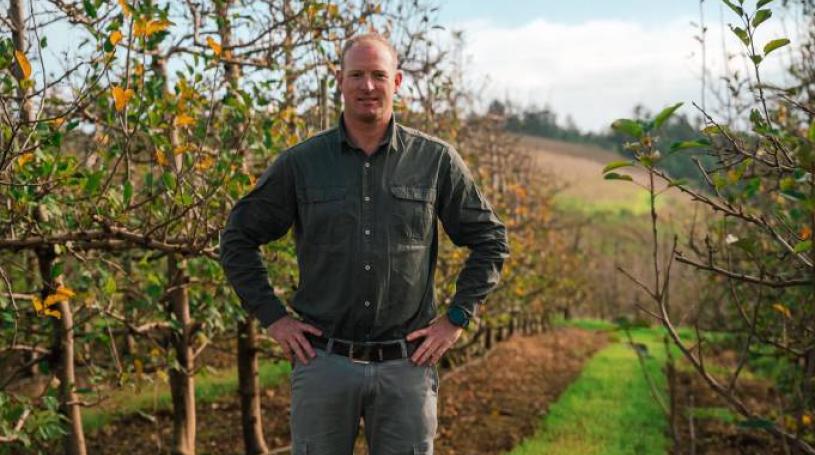
A Q&A with Western Cape Young Farmer of the Year, Richard Hutton-Squire. The Elgin fruit exporter opens up about the reality of climate change, the recent May storm damage, and managing 550-strong teams in a volatile climate.
Cape Chamber: Tell us about your farm? You farm apples and pears? How big is your footprint and what is your market?
Richard Hutton-Squire: We are a family farm. I am the CEO of Hutton-Squire Farms. We farm 270 ha of apples and pears, mainly for export, on 4 separate units (3 in the Elgin valley and 1 in Villiersdorp.) We are the second biggest supplier to Kromco. Kromco stores, sorts, packs and markets our fruit in many different markets across the world. The most important markets are UK, Far East, Middle East, Africa etc.
Cape Chamber: How did you get into farming? Does farming run in the family?
Richard Hutton-Squire: Farming runs in the family. My grandfather originated from a farm in Yorkshire in the UK and bought the first small farm in Elgin in 1948. I started working on the farm in 2005 and developed a passion for fruit farming which led to studies at Elsenburg and an internship in Washington State, USA. I returned in 2011 and have been working here ever since.
Cape Chamber: What do you most enjoy about what you do?
Richard Hutton-Squire: I enjoy the technical challenges of farming fruit and the satisfaction when we have high volumes of export quality. To get this done I have to spend time in the orchards with the teams making sure the details are being taken care of.
Cape Chamber: Did you have any particular mentor or inspiration to help you along your way?
Richard Hutton-Squire: My father has been an inspiration to me. I have developed his passion for fruit farming as well as his approach to work ethic. You only get out what you put in.
Cape Chamber: What is the most challenging aspect of your work?
Richard Hutton-Squire: Apple and pear farming is very labour intensive. In peak season we are employing up to 550 people. It is challenging to build motivated teams to execute tasks at a very high standard. This requires a very structured approach so everyone knows what is expected of them as well as a strong value system.
Cape Chamber: The Western Cape agricultural sector is very strong and has been for many centuries. Are you mindful of the legacy/heritage aspect of farming?
Richard Hutton-Squire: I believe that farming is a very noble career choice. There are many long hours and hard work that a farmer puts in that the customer doesn't see. I want to build a brand that will last well into the future. My family has been farming for many generations. We are here to do a job, feed the world and create employment.
Cape Chamber: Farming organisations have been outspoken about the recent surge in input costs, particularly fuel and fertilizer. How serious is this, and what would you say are some of the other significant challenges limiting the growth of the agricultural sector?
Richard Hutton-Squire: Input costs will always be on the rise. Significant surges in costs have a serious effect on the farmer when they can't pass these costs on to the consumers. Agricultural products are treated as commodities and this makes things difficult when returns are lower. As an exporter we face major constraints at the Port of Cape Town, recently rated as the worst container port in the world. This creates a bottleneck for the Western Cape's agricultural produce, sometimes leading to losses and a possible decrease in market share.
Cape Chamber: Is climate change a reality so far as you can see? Would you say we’re seeing an increase in extreme weather events, and how badly were you impacted by the last major storm (last month)?
Richard Hutton-Squire: Yes, climate change is a reality. It is something that I have observed over the last 25 years. The weather patterns that we experience in our area are not the same as they were when I was growing up in Elgin and Villiersdorp. We are seeing an increase in extreme weather events and sometimes the intensity is also more than I have experienced in the past.
We were impacted by the storm in May. Extreme winds caused roof damage and caused many Oak trees to break limbs or fall over. One oak tree fell over and blocked a river. This caused the river to divert through a new development eroding many cubic meters of top soil. We didn't have much crop damage because we worked 3 Saturdays in a row beforehand as well as a Sunday to harvest the later cultivars. Climate change puts many crops at risk due to high winds, flooding and extreme heat. El Niño could also cause an extended period of drought affecting many areas including our farms in Villiersdorp.
Cape Chamber: Notwithstanding the aforementioned challenges, would you say the sector is getting better in terms of international competitiveness?
Richard Hutton-Squire: The South African apple and pear sector has always been strong due to the demand for its high quality fruit. The Western Cape produces fruit with an exceptional eating experience that will always be in demand. We are also able to remain competitive due to the abundance of reasonably priced labour in South Africa. Compared to other apple growing regions in the world, our labour cost per hour is one tenth of their costs—if they can find labour at all.
Cape Chamber: Lastly, if you had a magic wand, what would be your one government reform and/or assistance measure you would effect to help local farmers?
Richard Hutton-Squire: Our labour struggles to access affordable housing and basic health care services in the area. I believe that we would have a much happier and more productive workforce if all of our employees had a good stable roof over their heads and access to healthcare. To achieve this, the government and local municipalities should be investing in more housing projects and building schools, clinics and community centres. Farmers are open to well-managed public-private partnerships to get things moving. This is a common theme in most Western Cape agricultural towns and it is not sustainable. Families living in overcrowded shanty situations cannot perform at their best.