
Unlocking Culemborg: Q&A with Councillor Ian McMahon
Following a landmark High Court order, Ward 115 Councillor Ian McMahon discusses clearing the Culemborg precinct, state-owned land collaboration, and balancing port logistics with affordable housing.
1. As you point out, the Culemborg site has huge value and could be catalytic, particularly for the Port. Are you confident that the site will indeed be cleared by the 30 September deadline, or do you see trouble ahead?
MCMAHON: The High Court has now provided legal certainty and a clear implementation process. The Court has ordered that the occupiers vacate the site by 30 September 2026, failing which the Sheriff is authorised to execute the order, with the assistance of SAPS if required.
My experience with other unlawful occupation matters in the CBD is that occupiers generally remain in place until the Sheriff arrives to execute the Court’s order. An eviction of this scale also requires careful operational planning, coordination, and preparation. Based on previous experience, that process can take approximately 40 days from the court-ordered vacation date, although the exact timing will depend on the Sheriff and the agencies involved.
For that reason, I would not necessarily expect the site to be fully cleared on 30 September itself. My hope is that the order can be implemented peacefully, safely, and with dignity for everyone involved.
The real opportunity lies beyond the eviction: finally unlocking one of Cape Town’s most strategically important precincts.
2. A lot has been said about the Culemborg site and how vital it is with regard to both future Port operations and housing provision. You’ve seen the Transnet Port Plan. Do you get the sense that things are finally moving ahead?
MCMAHON: I do.
The Transnet plans demonstrate that Culemborg is not simply surplus land. It is intended to become a modern intermodal logistics precinct supporting the Port of Cape Town and strengthening the city’s freight network. Given Cape Town’s role as South Africa’s export gateway, that strategic function is nationally important.
The Court’s judgment removes one significant legal obstacle to that vision. It does not mean construction begins tomorrow, but it does provide the certainty that has been absent for a long time.
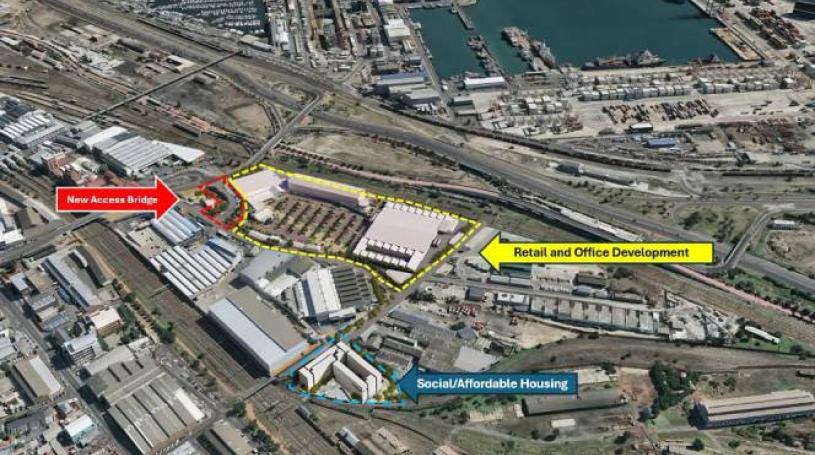
What encourages me most is that we are now seeing movement across the broader precinct, not just on Transnet land. PRASA is advancing plans for mixed-use development nearby, including commercial activity and affordable housing, while investment in the Central Line Railway Safety Barrier Project will improve safety and accessibility. If these projects progress together, they have the potential to transform one of Cape Town’s most important gateways into a precinct that supports logistics, employment, housing, and investment.
3. From what I can see, the project deadlines have been missed. Any insight into the reasons for the long delays? Illegal occupation appears to have been one reason for delays, but some have suggested there was a deficit of political will to utilise this area to its full potential. What is your view?
MCMAHON: I think it would be too simplistic to attribute the delays to any single factor.
Major public-sector developments of this scale involve years of planning, engineering, environmental approvals, funding, procurement, and stakeholder engagement. The unlawful occupation undoubtedly added another layer of complexity because the constitutional requirements under the PIE Act had to be satisfied before the land could realistically be developed.
Rather than looking backwards, I think the more important question now is whether all stakeholders can build on the momentum created by the judgment. We have an opportunity to move from litigation to implementation.
4. The Mayor and Premier have both flagged Culemborg, together with sites such as Wingfield and Ysterplaat, as suitable for affordable housing. It would seem Transnet has made provision for this in its Port Plan. What is your view? Should more of the precinct be made available for housing, or is that area more suitable for industry and future port expansion?
MCMAHON: I do not believe this should be framed as a choice between housing and economic development.
From the Transnet plans I have reviewed, it is clear that the broader Culemborg precinct has the capacity to accommodate complementary land uses. Certain portions are strategically important for future port-related logistics and “back-of-port” operations, while other areas present opportunities for commercial development and, where appropriate, well-located affordable housing.
Nearby PRASA proposals already point in that direction, with a mixed-use vision incorporating retail, commercial activity, and affordable housing. Rather than viewing these projects in isolation, I think we should be planning the precinct as an integrated gateway into Cape Town.
Successful cities do not force a choice between jobs and housing; they create places where people can both live and work. If Transnet, PRASA, and the various spheres of government work together, I believe Culemborg and the surrounding precinct have the potential to become one of Cape Town’s best examples of integrated urban regeneration.
5. Do you see other opportunities for that area, such as retail? Is there talk of selling off some of the land?
MCMAHON: I certainly see opportunities for complementary land uses.
The nearby PRASA proposals include retail, commercial space, affordable housing, and improved connectivity through a new access bridge. Those proposals demonstrate the value of thinking about the entire precinct rather than individual sites.
Whether land is ultimately sold, leased, or retained by state entities is a matter for the relevant landowners. My focus is that these strategically located public assets should be actively used to generate jobs, improve safety, support public transport, and contribute to Cape Town’s long-term economic growth.
6. Would you say there is currently a “window of opportunity” for the different tiers of government to work together in a more constructive way to unlock value in these key pieces of real estate, both Culemborg and the other sites currently held by the Department of Defence?
MCMAHON: Absolutely.
I think there is a genuine window of opportunity.
Cape Town’s future growth increasingly depends on making better use of strategically located public land. That requires collaboration between all spheres of government, state-owned entities, and the private sector.
No single organisation can unlock these precincts on its own. The opportunity lies in coordinated planning, shared objectives, and a willingness to think beyond individual land parcels towards integrated precinct development.
7. Lastly, is the City of Cape Town actively involved in trying to promote this collaboration and decision-making around land utilisation?
MCMAHON: Yes.
The City is involved across multiple disciplines, including planning, transport, legal services, housing, public safety, and economic development.
One of the key lessons from Culemborg is that successful urban regeneration depends on sustained collaboration between institutions. The City has an important role to play, but so do Transnet, PRASA, Home Affairs, the Western Cape Government, and National Government.
Ultimately, I hope the Culemborg judgment will be remembered not simply as an eviction, but as the point at which one of Cape Town’s most strategically important precincts finally began moving towards the future it deserves.