
SA's unemployment shocker
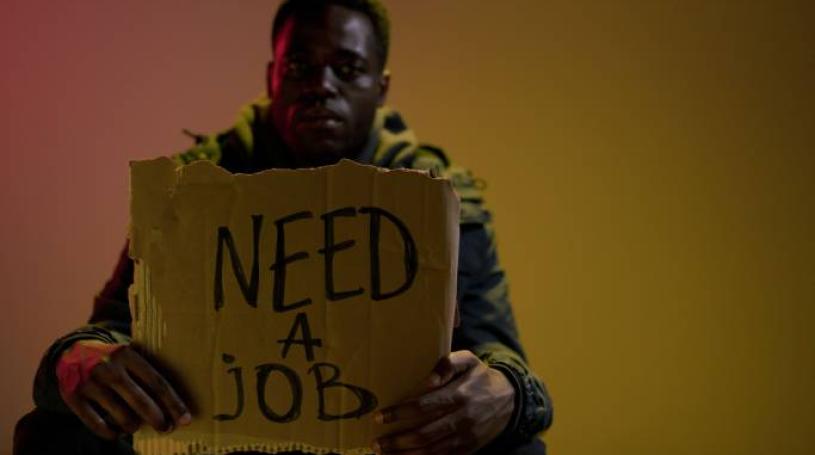
It's tempting to call the latest quarterly unemployment figures another wake-up call, but the truth is there will be no quick escape from a structural nightmare.
While news headlines track the Madlanga Commission and the incoming All Blacks, the country's unemployment rate has quietly crept up to 33,6%. If you include discouraged work seekers – those no longer actively looking for work -- our unemployment rate is well above 43,8%.
That's more than five times higher than the average unemployment rate for a developing nation.
It is a measure of our national ability to coexist with disaster that these abysmal stats no longer seem surprising; we seem so accustomed to inequality that we simply take note and move on, perhaps reassuring ourselves that things could be even worse.
In fact, if you exclude the Covid era (up to and including the second quarter of 2022) when the unemployment hit a peak of 35,3%, these latest stats ARE the worst we've had in the democratic era. One out of three adults is now looking for work. By comparison with other provinces, the Western Cape's 19,5% unemployment rate is somewhat better but it is by no means cause for celebration. If anything, it underscores the importance of working to improve the underlying business environment.
In 2026Q2, the Western Cape created 91 000 jobs year-on-year, marking the highest increase in employment in the country. Measured against the job losses in almost every other province, the stats suggest the focus on economic growth is fundamental to improved national statistics.
Widespread unemployment not only has dire consequences for those directly affected; it is a recipe for social instability that affects us all in South Africa. It threatens to undo the many gains we have seen over the past couple of years.
We know this. But what are we doing about it?
Fortunately, there is already much work being done.
Despite the gloomy statistics, public-private partnership is expanding – a vital step in restoring confidence needed to attract investment and create jobs. We have enough capable people and resources to turn things around. With the right leadership, we need to identify priorities and allocate resources to competent persons instead of cadres.
Together with our members and social partners, the Cape Chamber of Commerce and Industry is actively driving grounded, practical interventions to strip away the barriers holding back business and employment. We are just one of multiple organisations actively moving beyond passive commentary, to rather implement solutions wherever possible.
The cost of standing still is too high.
World Bank findings peg the total economic toll of crime in South Africa at roughly 10% of GDP annually (equivalent to roughly R700 billion). Cleary, we need model solutions to make our communities and workplaces safe again.
We have chosen Philippi East, which has one of the highest levels of violent crime, to demonstrate how partnerships and competence can radically improve safety and security. Located on the doorstep of communities hit hardest by structural unemployment, this precinct has significant economic potential. Yet for years, infrastructure neglect, crime, and logjams have choked off investment. By rallying local enterprise, municipal stakeholders, and security initiatives onto the ground, we are working to make Philippi East a much safer, viable hub where local businesses can operate, expand, and hire.
Simultaneously, we are tackling industrial competitiveness through our Scaled Labour Intensive Manufacturing (SLIM) project. Led by industry veteran Graham Choice, this initiative is establishing a prototype industrial park designed to slash operating costs for manufacturers. By introducing smarter work schedules, shared utility management, and lower overheads, SLIM provides a viable, low-cost blueprint to reignite labor-intensive sectors like textiles and light manufacturing.
Finally, to fix a broken environment, we need to understand where it hurts business most. Assisted by the Bureau for Economic Research (BER), we recently launched the National Business Environment Survey. By gathering direct, unvarnished operational data from business owners across every sector and region, we are building a valuable evidence base to give us the leverage needed to hold public institutions accountable, and to lobby for more targeted, localised policy fixes that actually unlock growth.
These are just a few projects on the go, often happening without fanfare and behind-the-scenes.
The latest unemployment stats are another reminder that the private sector cannot expect government to produce a magic wand to dispel our economic woes.
The alarm clock is still ringing, but there is no snooze button left to press.
It is time for more of us to roll up our sleeves, and work—together, to shape a future with much better employment opportunities.
John Lawson, CEO of the Cape Chamber of Commerce and Industry