
Q&A with Warren Spiro: How Pienaar Brothers built an industrial safety empire
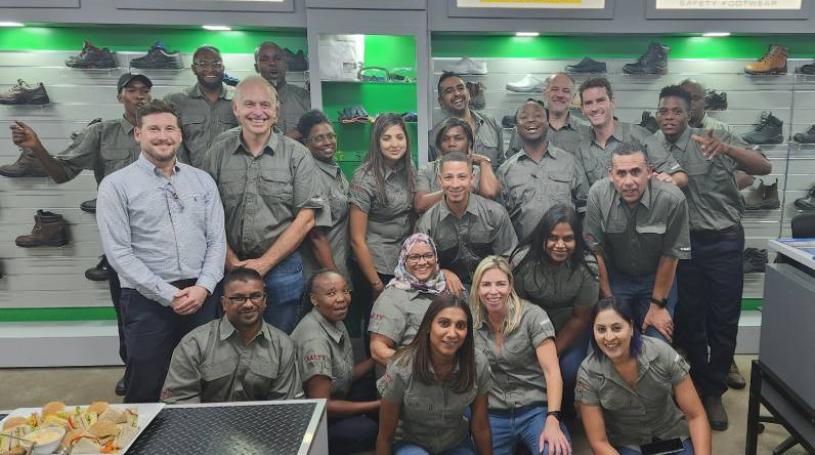
In this exclusive executive interview, Pienaar Brothers CEO Warren Spiro traces the company’s 70-year evolution from a single farm-to-farm delivery service—where local farmers mistakenly named the business after a surname they could actually pronounce—into a national safety equipment giant.
Who founded the company, and what was the original product scope?
Pienaar Brothers was founded by Alex Lapiner in 1956, with a very simple purpose: to provide farmers with whatever they needed. At the time, there were no co-operatives or established distributors serving many of the farming communities around Worcester. Alex saw an opportunity to fill that gap. He would travel into the city, purchase anything and everything that farmers might require, load it into his car and then drive from farm to farm, supplying them directly.
I believe the name Pienaar Bros has an interesting origin story. Could you explain?
The story behind the name is quite an interesting one. The market Alex was supplying at the time was predominantly Afrikaans-speaking, and the surname “Lapiner” wasn’t a name that people were particularly familiar with. Rather than wrestle with “Lapiner”, customers began referring to him as “Pienaar” — a surname they knew and were more comfortable with.
When Alex’s brother later joined him in the early days of the business, the company naturally became known as the “Pienaar Brothers”. The name simply stuck. What started as a practical adaptation by the customers the business served ultimately became the name that has represented the company for the past 70 years. It’s a rather unusual origin story, but it is also a nice reflection of how closely the business was connected to its customers from the very beginning.
The Company has grown substantially since the early days. What would you say was the main driver of this growth, and how has the company diversified since then?
My grandfather wasn’t just selling products; he was solving problems. That simple philosophy has quietly guided every generation of the business. When Alec started out, the problem was obvious. Farmers needed someone they could rely on. There were no distribution centres, online ordering platforms or overnight courier services. If a customer needed safety footwear, mutton cloth, cleaning materials or stationery, Alec would source it himself, load his vehicle and deliver it personally. He wasn’t trying to build a company. He was helping people solve everyday problems. The business grew because customers trusted him.
Long before anyone spoke about company culture, that willingness to help and solve a problem had already become part of the business. As the company grew, the problems changed. Howard Spiro, who married Alec’s daughter Vivian, brought the business discipline and financial insight needed to transform an entrepreneurial venture into a sustainable company. His steady stewardship enabled Pienaar Brothers to expand its footprint throughout the Western Cape, the coastal regions, and the Northern Cape. At the same time, Alec’s son, Brian Pienaar, recognised that South Africa’s mining industry faced very different challenges. He established what became known as Pienaar North, building a specialist business that supplied mines and heavy industry through a network of branches, warehouses and pioneering on-site stores.
When I joined the business, the challenge changed once again. Customers no longer needed someone simply to supply products. They needed expertise. They needed information. They needed faster service. They needed a partner who could help them navigate an increasingly complex world of workplace safety. I focused on strengthening the company’s brand, invested in technology, sought to improve the way customers accessed product information and invested in long-term relationships with manufacturers around the world. At the same time, B-BBEE became a reality within the South African commerce space, and we had to gear up and make significant changes to achieve our level 1 status.
Where are you currently based, and what is your key target market?
Our head office is based in Paarden Eiland in Cape Town, and from there we support a growing network of branches across South Africa. We currently have a presence in Kathu, where we operate both a physical branch and an on-site store, as well as Upington, Saldanha Bay, Paarl, Worcester, Gqeberha (Port Elizabeth), East London, Mossel Bay, George, Durban and, most recently, Pietermaritzburg. Our key target market is the industrial and agricultural sectors with a focus on construction, manufacturing, mining and other industries where occupational health and safety is critical. We supply head-to-toe personal protective equipment, supporting businesses of all sizes — from individual sites and smaller businesses through to large industrial and mining operations.
Our geographic expansion has been driven by the same philosophy that has guided the business since 1956: being close to our customers and understanding the specific challenges they face. Different regions and industries have different requirements, and having people on the ground allows us to provide a more responsive, knowledgeable service rather than simply operating as an online or transactional supplier.
Local manufacturing is under pressure, and many local manufacturers complain about imports. Are imports a concern for you, either from a cost or price point of view?
It’s a two-fold answer for us: yes and no.
On the positive side, imports have given South Africa access to some of the world’s leading PPE brands, such as 3M and uvex, with significant investment in research, development and technology. Access to this level of innovation can only be a positive for the safety of the wearer. Imports also allow us to source compliant PPE at a more accessible price point, thanks in part to the economies of scale achieved by large international manufacturing plants. Ultimately, if we can make quality, compliant PPE more affordable, more people can be better protected.
In the same light, the ease of importing products, combined with the extremely competitive prices that can be achieved in the East, has also resulted in an increase in non-compliant products entering the market. That is where our concern lies. The East has the ability to manufacture almost anything to a specified cost, but there is often a reason why one product is significantly cheaper than another. When you are talking about PPE, you are ultimately talking about protecting someone's life, and that comes with a responsibility to source and supply products that are properly tested, certified and compliant with the applicable standards. These tests and the modifications to products that they often drive are what drive the unit cost up.
There is also a responsibility that extends beyond simply looking at a certificate or a product specification. We need to have confidence in the manufacturers behind the products we supply. Do they consistently manufacture to the quality they claim? Do they maintain those standards from one production run to the next? Do they have a genuine commitment to safety, or are they simply producing to meet a price? For us, that is why the relationships we build with our international suppliers are so important. We choose to work with manufacturers and brands that have demonstrated their commitment to safety and quality over many years, rather than those whose only selling point is a low price. So, while imports can certainly put pressure on local manufacturers, we don't believe that imports themselves are the problem. Responsible access to global manufacturing, technology and economies of scale can be hugely beneficial to the South African PPE market. The concern is when price becomes the only consideration and compliance, quality and ultimately the safety of the wearer are compromised.
In saying that, we also recognise the importance of supporting local manufacturing where it makes sense. The objective should not simply be to choose local over international, or international over local. It should be about creating access to quality, compliant PPE at a price that allows businesses to protect their people properly — and ensuring that safety is never compromised in the process.
Government recently moved to clamp down on quality control by proposing a system of pre-export approvals from China. The initiative has been put on hold, but it put a spotlight on the issue of unregulated goods entering the SA market. Is this a concern?
Most definitely, and we hope that the leading brands and distributors within South Africa can work alongside government to bring this initiative back to the table. There are a few reasons why we believe this is important. At present, there is already significant pressure on customs in South Africa to assess and authorise the compliance of imported PPE. This requires an understanding not only of the relevant standards, but also of the price points, materials and overall construction of different products. That is a significant responsibility, and there will inevitably be products that slip through the system. The challenge is that, once a non-compliant container has landed in South Africa, those products are already here. Even if they don't find a legal route into the market, there still needs to be some level of control over how those products are managed and ultimately disposed of.
Another concern is that compliance is not always obvious to the end user. Anyone can print a standard or certification reference on a product or its packaging. The average person on the street, and even many businesses purchasing PPE, do not necessarily have the training or expertise to look at a product, a brand name or a certification marking and determine whether it has genuinely been through the necessary testing and meets the required standard. That is why we believe this needs to be approached proactively rather than relying solely on checks once goods have arrived on South African soil. Pre-export approval would place a level of responsibility further up the supply chain and could help prevent non-compliant products from entering the country in the first place.
Ultimately, if protecting human life remains a priority for South Africa, then protecting the integrity of the PPE that enters our market must be taken just as seriously. We believe government and the PPE industry have a shared responsibility here, and we would welcome the opportunity to work together on a system that strengthens quality control without unnecessarily restricting access to legitimate, compliant and competitively priced products.
The Chamber is trying to highlight some of these problem areas. Would you say business Chambers have a role to play in improving the business environment and making business more competitive?
It’s a shared responsibility amongst all the key players in industry: government, local manufacturers, distributors, end-users and of course Associations and Chambers.
Pienaar Bros has a strong CSI drive. Can you expand a bit more on why education is the pillar you invest so largely on?
One of the greatest privileges that comes with Pienaar Brothers’ success is being able to give something back and, more importantly, to create opportunities for others. Whether it is helping a young child start school, supporting a university student pursuing their dreams or giving one of our own employees the opportunity to advance, we believe education has the power to change the trajectory of someone’s life.
If we can help change someone’s future, then we have achieved something that goes far beyond commercial success. That is why education has become such an important pillar of our CSI investment.
For many years, we have proudly partnered with Ikamva Labantu, a remarkable women-led organisation that has spent more than six decades uplifting vulnerable communities across Cape Town. This winter, that partnership once again brought warmth to children through the donation of beanies, scarves and gumboots, helping ensure that they could face the colder months with dignity, comfort and confidence. While these may seem like simple necessities, they can make a meaningful difference to a child’s ability to attend school and participate with confidence.
We also contribute around R900,000 each year towards bursaries at the University of Cape Town, the University of the Western Cape and the Cape Peninsula University of Technology. These bursaries help talented students from previously disadvantaged communities access higher education and, ultimately, fulfil their potential. For us, it is about more than funding a qualification; it is about helping remove one of the barriers that can stand between a talented young person and the future they are capable of achieving.
Closer to home, we invest heavily in training and upskilling our own people. One of the initiatives we are particularly proud of is helping employees who did not have the opportunity to complete their matric to do so. We believe learning shouldn’t have an expiry date, and that it is never too late to give someone the opportunity to develop themselves and open new doors.
For us, education is ultimately about opportunity. It gives people knowledge, confidence and choices. And if, as a business, we are fortunate enough to be in a position to help create those opportunities for others, then we believe we have a responsibility to do so.