
My Enterprise: From scrapyard spares to global trailblazer - Mom's quest to care for disabled daughter built a manufacturing niche
It started with a small electric wheelchair; a prototype whose parts included a second-hand windscreen motor found at the scrapyard.
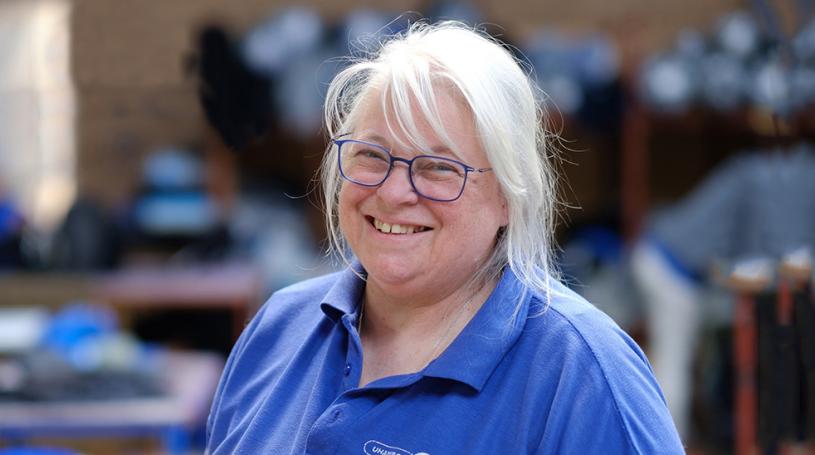
Shona McDonald was determined to value her disabled daughter’s life, no matter the effort required.
“One of my daughters was born with severe cerebral palsy, a birth injury – and our advice was to put her in an institution and have another child,” Shona recalls. “I wasn't prepared to accept that.”
Instead, Shona decided to do what many believed impossible: create the support and provide the equipment herself. In doing so, she not only reshaped her daughter’s life, and assisted many others, she built an entire manufacturing niche and shaped a new market where none had previously existed and developing training programmes beyond anybody’s expectations.
Fast forward to February 2026. Shona and her team have just launched a Centre for Inclusive Innovation and Entrepreneurship. Not only is she developing and manufacturing her own products, she and her team are helping many others do the same.
“The idea is to identify, help and support other innovators like me take their ideas which are suitable for the lifestyle we have here in Africa, prototype them, test them and get them into manufacture, right here where they are needed.”
“For me, getting South African solutions that enable us to be independent of imports is so, so important -- and so exciting. If we talk about job creation, why are we importing assisted technology when we could manufacture it here?”
These product development programmes are being integrated into her production facility in Ottery, Cape Town, where she works with a team of around 80. The products are all assistive devices for people living with disabilities, ranging from low vision aids to a solar powered wheelchair for children younger than five.
“We’re currently working on two prosthetic knee joints, one that emerged from the Imperial College of London, and one being designed right here by a student in Cape Town,” says Shona.
To get to this point, Shona’s life has taken more twists and turns than anything she produced as a professional artist and sculptor, her previous occupation. In many ways her business journey has tracked the development of democratic South Africa.
As a single mom looking after three children, she had her hands full, particularly upon realising that the equipment she needed for her daughter wasn’t available locally due to international sanctions. In this predicament, she also realised she was far from alone.
Most parents she met were in the same situation, particularly those living in under-resourced households in informal townships.
“Only folding transporter chairs were available for adults, and there was no assistive technology available at all for children.”
“It took me about a year-and-a-half to realise there were so many other people who couldn’t access anything. It was an impossible situation.”
Thus her journey began, slowly at first but gathering momentum as her network grew. It was also a lesson in humility; she found herself exploring and reaching across the apartheid divides of the early 1980s to learn from those whose need was as urgent as her own.
“When my daughter was only about a year old, I started meeting all these other parents living in townships and informal settlements, with children struggling with all types of disabilities. I started driving out into other areas, met in clinics and sat in people’s homes, people were so welcoming. That is when I started realising the need for assistive technology that matched our children’s clinical and functional needs.
Those interaction led to the formation of a non-profit, the first of many initiatives that emerged from Shona’s activism and her growing work in assistive technology.
She realised early on that local products would need to cater for local conditions, and more outside living, rather than mimic European designs.
A key turning point came through a meeting with a University of Cape Town biomedical engineer, who helped Shona build her daughter’s first electric wheelchair whose parts included a discarded Land Rover windscreen wiper motor found at the local scrapyard. “By 18 months my daughter was independently driving her first wheelchair.”
At the same time her daughter was learning to read with assistance from one of Shona’s friends, which prompted further advocacy for inclusive education. By age nine she had been accepted into a local mainstream school.
Advocacy developed alongside Shona’s assistive technology work. Initially, she worked out of her garage, building her own chairs. “Eventually I had so many staff it filled up my entire house in Plumstead – about 35 people .” She has since expanded into a dedicated production facility.
Over the years the different initiatives evolved into a hybrid social enterprise called ShonaquipSE, combining business and community programmes. It comprises various organisations, among them the Uhambo Foundation which focuses on capacity building in under-resourced communities, and the Champions of Change Trust, which provides access and information for families and caregivers.
Although business growth and financial support has generally been strong, recent geopolitical dynamics have created economic headwinds, not least the discontinuation of USAID grant funding. Shona and her team continues to navigate this environment.
Through it all she remains focused on her core mission: shifting society’s thinking around disability. “Somebody with disability is not a broken person that you have to hide away in an institution. It is the systems that are broken when they fail to recognise and treat all people as equally valuable.”