
Congestion surcharge for Cape Town? Q&A with Prof Stephan Krygsman
Professor Stephan Krygsman is a logistics expert from Stellenbosch University. He was a panellist at the Cape Chamber's recent Urban Mobility Strategic Dialogue Network (SDN) event
CHAMBER: Professor, you spoke last month about cities as drivers of economic growth, and the need to reframe the public transport challenge in economic terms. Do you mean that transport stakeholders need to examine more closely the relationship between companies and their workforce?
SK: Yes. Typically, companies have three major input costs, i.e. land, labour, and transport. Labour is an important element. We find labourers spend a significant proportion of their disposable income on transport. Long travel times and travel distances together with uncomfortable travelling options lowers productivity (tired workers). It also leads to high churn in employment, i.e. workers continuously look for higher paying jobs or jobs closer to their home to overcome the burden on the long commute. This high churn causes losses in terms of productivity and companies needing to train the new workers. Furthermore, ineffective public transport leads to late arrival and it is very difficult to schedule workers in tasks and shifts. It is outside of the workers’ control and employers obviously do not find such a situation acceptable.
What we also find is the many companies, specifically logistics firms, are moving to outlying areas on the edge of the city. Several factors are driving this move, including land costs, the need to be near transport (read roads), the ability to operate 24/7, and importantly, the need to be closer to their workforce. This is what came out of a survey recently of logistics firms; they stated that one of the reasons they are choosing their new location is because they want to be close to the workforce.
CHAMBER: You also pointed out that the current five main transport nodes tend to cannibalise each other, and don't stick to separate catchment areas. Is this a problem of fragmentation?
SK: See below a table from the latest CITP. The figures may be a bit outdated:
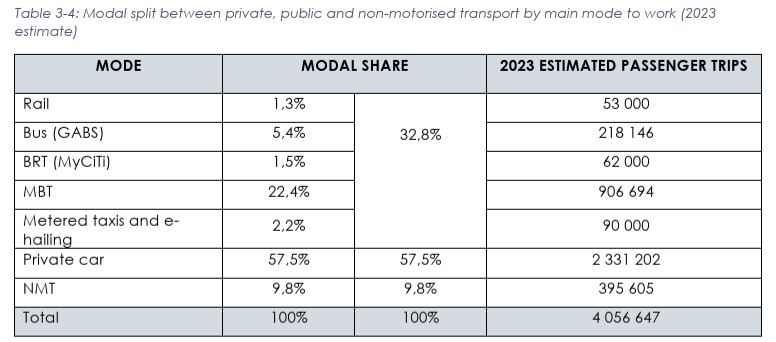
If we assume that there are +/- 4 000 000 passenger trips per day in the city (the large majority of trips are to work and back, i.e. the daily commute = 2 trips per person) and we have half of the people travelling with the (1) car, (2) some with Golden Arrow, (3) BRT, (4) rail and (5) minibus taxis and then odds and ends with NMT, the problem becomes clear. See the table above. If Rail is to return to the pre 2016 values of +/- 600 000 - 700 000 they will have to take from car, Minibus, bus or BRT to really influence congestion. And then specifically the car and minibus. But rail is not really planned (alignment of routes and services) for the car users and so the major market is really minibus. I sincerely doubt the minibus taxis will relinquish their market share.
Also, rail and BRT have inherent economy of scale characteristics. That is, the bigger they area and more people use them, the cheaper they become. Currently, these two modes are probably operating far below this optimum level and require significant subsidies to operate.
Minibus and bus do not have such economy of scale implying that their average costs remain the same, (mostly) independent of the number of vehicles used and passengers transported. So, there is a lot of benefits in using rail and increasing its market share. It should benefit everyone in terms of lower transport costs and less subsidy requirements. But Rail and BRT is probably competing for much the same market share and none of them will achieve their optimal size if they compete.
If you look at most successful cities in the world, they typically have two and maybe three public transport modes, mostly rail and bus. South Africa has five public transport options. This splits the market and leads to lower than optimal market share and increases in subsidy demands and, of course, higher public transport charges. While we need integration, we first need sound coordination of competition and regulation. And then integration of the chosen public transport modes. This fragmentation prevents any single mode (especially rail) from reaching the critical mass needed for efficiency and lower unit costs
CHAMBER: As was pointed out at the SDN, some of these challenges have existed for many years. What in your opinion is the biggest stumbling block limiting progress in this area? Do you agree that there is a fundamental disconnect between different tiers of government?
SK: Absolutely. This is probably the biggest problem. You have three tiers of Government, i.e. National, Provincial and Local. National takes care of rail (and collects most of the taxes!); Provincial Government subsidises bus (GABS); and Municipal plan public transport (such as BRT) but get funding from national PTOG and PTIG). And taxis are a law unto themselves. And then you have SANRAL responsible for national roads.
To make matters worse, you have the City with a (a) Mobility Department and a (b) Urban Planning and Design Department and a (c) Development management Department! All of them are in some way responsible and involved with transport. A recipe for complete failure.
Ideally you need an Urban and Transport Development Authority (stronger than a department with the ability to raise its own funding) that coordinates everything, including the (1)planning, design and construction of transport, (2) competition , regulation and coordination of all the modes in the functional area of the metro, and (3) control of the funding and financing of infrastructure. These should not be political appointments and operate independent of the political parties. And very important, this unit should be at the Municipal/Metro level, it should have control over coordination modes, allowing competition and regulating the industry and very important, must focus more on land use planning, as transport is a derived demand.
In short, you need political independence and long-term continuity – this is one of the biggest practical problems.
CHAMBER: You also spoke of the spatial challenge, and that spatial challenges are being entrenched rather than addressed. Are you mainly referring to the Apartheid legacy of labour being forced out to the periphery, far removed from the CBD and industrial areas?
SK: We observe with ongoing urban sprawl and traditional planning approaches that residential areas, employment areas, industry, manufacturing etc. Are all planned separately. This leads to very monotonous land uses, i.e. residential is split from manufacturing from retail etc. And of course this leads to the need to travel. Why not relax zoning regulations at public transport stations and allow people to build houses with the bottom floors used for businesses and the top floors for residential? Similar to what we are doing in the CBD (just formally). Also allow hairdressers, small shops, retail and light manufacturing, etc. in neighbourhoods. This will allow people to balance home and work in close proximity, avoiding the need for long travel. it becomes a 15-minute city. And we should design and build neighbourhoods that contain many of the local facilities that people need: banks, small shops, pre-school, some light industry, and employment. It creates a vibrant local economy. These neighbourhoods must then relate to public transport to the large employment centres and other neighbourhoods. A typically hub and spoke development pattern.
Then we also have large tracts of land in the CBD, such as the Wingfield and Youngsfield areas and other parcels of land that are not used optimally. Surely, we do not want army facilities in these areas in the City? Rather use these tracts of land for large, formal, and high-quality affordable housing but with mixed uses. Really something like Century City - a city within a city - people and work, play, study and live in the same area.
CHAMBER: And flowing from the above, what in your view is the best way to address this issue?
SK: This is where we need the proposed Urban and Transport Development Authority or Corporation that I mentioned above. A strong planning authority that is also responsible for transport. They undertake the overall spatial planning for the region, the city and then the precinct. They assemble the land (sperate parcels) and then establish the joint ventures between public and private to drive the development. So they will probably also establish the joint venturing institutions that develop the land with public authority, and the private sector the implementing agent. But this authority should have control over transport and land use and have powers to raise revenues. It should not be political appointments, and it should have a long-term vision, medium term planning, and strong project planning teams.
CHAMBER: The SDN also highlighted Cape Town's unique challenge in being the fastest growing city but also having unique geographic challenges that promote congestion — such as ocean and large mountain. How confident are you that the congestion problem can be alleviated before the city hits the ten million mark (possibly by 2050)
SK: If we keep doing what we are doing now, we will not solve any problems. We will have the same discussion in 5, 10 and 15 years.
A lot of people talk about the mountain and the sea as the geographic challenges, but these 'challenges' are really what makes the city very attractive in terms of less air pollution, amenities for sport and recreation, stopping excessive sprawl in all directions, etc. Most successful cities in the world have either a sea or a mountain. Cape Town has both. The mountain limits sprawl which is good. The sea allows trade and cleans pollution (air pollution) . Of course, the City is wedged between the sea and the mountain, but with good public transport connections, this can be addressed and solved.
The City is experiencing a lot in migration, because of (a)its somewhat successful governance, (2) better employment opportunities and (3) the inability of other cites to generate the same benefits. As people migrate to Cape Town, our only development option seems mostly to accommodate them on the periphery, and this leads to more travel as employment is in the CBD and some corridors. To address this, we need to focus on three elements:
Allow developments (good design, formal and structured) on open land closer to the CBD and employment nodes in the city, such as Wingfield, Ysterplaat, etc.
Allow Transit Oriented Development (TOD) around stations and public transport nodes. For example, like the Golden Acre development
allow for a polycentric city with some subcentres all connected with good public transport
Developers should not only undertake traffic impact studies but also housing impact studies and make significant contribution to public transport -- not only roads and parking
We can also consider moving the Port of Cape Town (or the container part) to Saldanha and build a very successful IDZ in Saldanha. The Port of Cape Town can then be a working port for fishing vessels, the cruise industry, patrol and research ships, sailing industry, etc. . This will free up a lot of truck congestion and allow us to build a secondary city at Saldanha, and it may even assist with access to employment and reducing the pressure on Cape Town
And finally, there is no other alternative to generate revenue for public transport other than implementing congestion taxes, developed contribution and privatising rail, stations, busses etc.
CHAMBER: Lastly, the Cape Chamber is outspoken about the need for greater private sector involvement in finding solutions to issues that impact on economic wellbeing. How best can the private sector exert an influence?
SK: The public sector should only be involved with governance, planning, regulation, coordination, etc. and not extend their role to “running” services. The operation of, the building, the implementation, of transport services and land developments should be left to the private sector. The only purpose of government (or the public sector) is to allow the private sector to function. Not to do the work of the private sector or the do work that the private sector can do. The private sector pays taxes, and it is this leverage that they should use to secure a role on an Urban and Transport development Corporation.