
Beyond the Volatility: Why the 2026 Election Outcome May Ultimately Benefit Business
Business has reason to be optimistic about the changing political environment reflected in the outcome of the local government elections -- but the potential for positive change inherent 'coalition governance' must be weighed against potential instability.
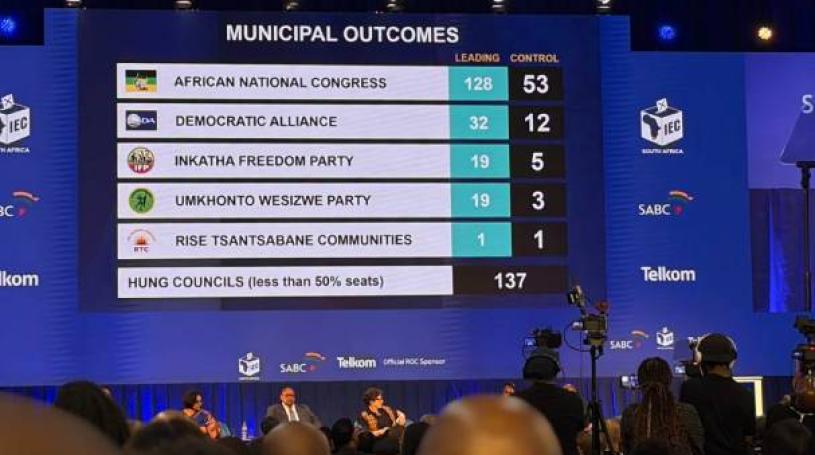
That's the general consensus among multiple business stakeholders who responded to Chamber queries about this week's elections, which resulted in more than double the number of 'hung municipalities compared with 2021.
While the DA hung on to its majority in Cape Town, none of the other seven metropolitan councils had a majority winner – and will therefore require formal coalition governance.
"I think on balance it will probably be more good than bad," commented Efficient Group executive director Dawie Roodt on the coalition trend. "Coalitions are certainly unstable things, we know that, but we've had some experience over the last couple of years with coalitions."
"There could be more coalitions which could theoretically lead to more unstable coalitions, but I think the political parties have learnt some lessons, and for that reason I think it is likely to be more stable -- which is likely to be good for business as well," Roodt said.
The poor performance of the ANC – which dropped nearly 15% compared with 2021 – could spark renewal within the party, Roodt added: "They have lost big time, and that means they will start pulling up their socks. And we have a couple new kids on the block (parties), and they want to prove that they can do a proper job."
"There will be a couple of exceptions as always , but I'm actually quite positive about this new political environment that we will find ourselves in over the next couple of years," Roodt said.
Lisette IJssel de Schepper, Chief Economist at the Bureau for Economic Research at Stellenbosch University, said the election results "present a mixed picture for business confidence".
"In Cape Town, political continuity and a relatively stable municipal government provide a degree of certainty. This matters for businesses making longer-term investment decisions, particularly at a time when municipal service delivery has become an increasingly important constraint on economic activity elsewhere in the country."
"Nationally, the picture is more complicated. The sharp decline in ANC support and the growing number of coalition governments introduce uncertainty, but coalitions are not inherently bad for business confidence. Much depends on the agreements reached, the stability of the resulting administrations and, importantly, their ability to improve service delivery and municipal financial management. There is potential for positive change, but the benefits will take time to materialise. For now, it is simply too early to tell where the balance will settle, with several very different coalition arrangements still on the table."
She said the possibility of municipal coalition negotiations spilling over into the Government of National Unity could result in uncertainty about the policy continuity and the reform agenda. "That could have more immediate implications for investor sentiment and financial markets," IJssel de Schepper said.
Madalet Sessions, Denker Capital head of Multi-Asset, said increased political competition was a potentially positive development: "I think the shift towards coalition politics could ultimately be positive for South Africa, although it might make governing messier in the short term. The potential benefit is that it introduces much greater competition into the political system."
"Parties can no longer rely as heavily on historical loyalties and increasingly have to compete on governance, service delivery and economic outcomes. If that competition creates stronger incentives for cleaner administration, more credible leadership and more pragmatic economic policy, it should be positive for business and investment over time."
"The obvious risk is that fragmented coalitions become unstable or paralysed, but I would distinguish that implementation risk from what I think is a potentially healthy structural change in South African politics," Sessions said.